Customer Churn Prediction
The Problem
Understanding what drives customer churn
Teams know churn exists, but don't know which signals are worth acting on. Public data let me explore how to tackle churn as a business problem that ML can help solve, not the other way around.
My Approach
Lead with discovery
- Goal: Identify at-risk customers earlier
- Core Constraint: Must be understandable to non-technical teams
- Success = Clear Insights: Explainable drivers, not peak accuracy
What I Found
Four consistent signals
- Early tenure matters most. Customers under 6 months churn the most.
- Longer contracts reduce churn. Two-year plans perform better than month-to-month.
- More services = more sticky. Bundling increases retention.
- Premium plans churn too. Price alone doesn't guarantee loyalty.
Try the live demo →
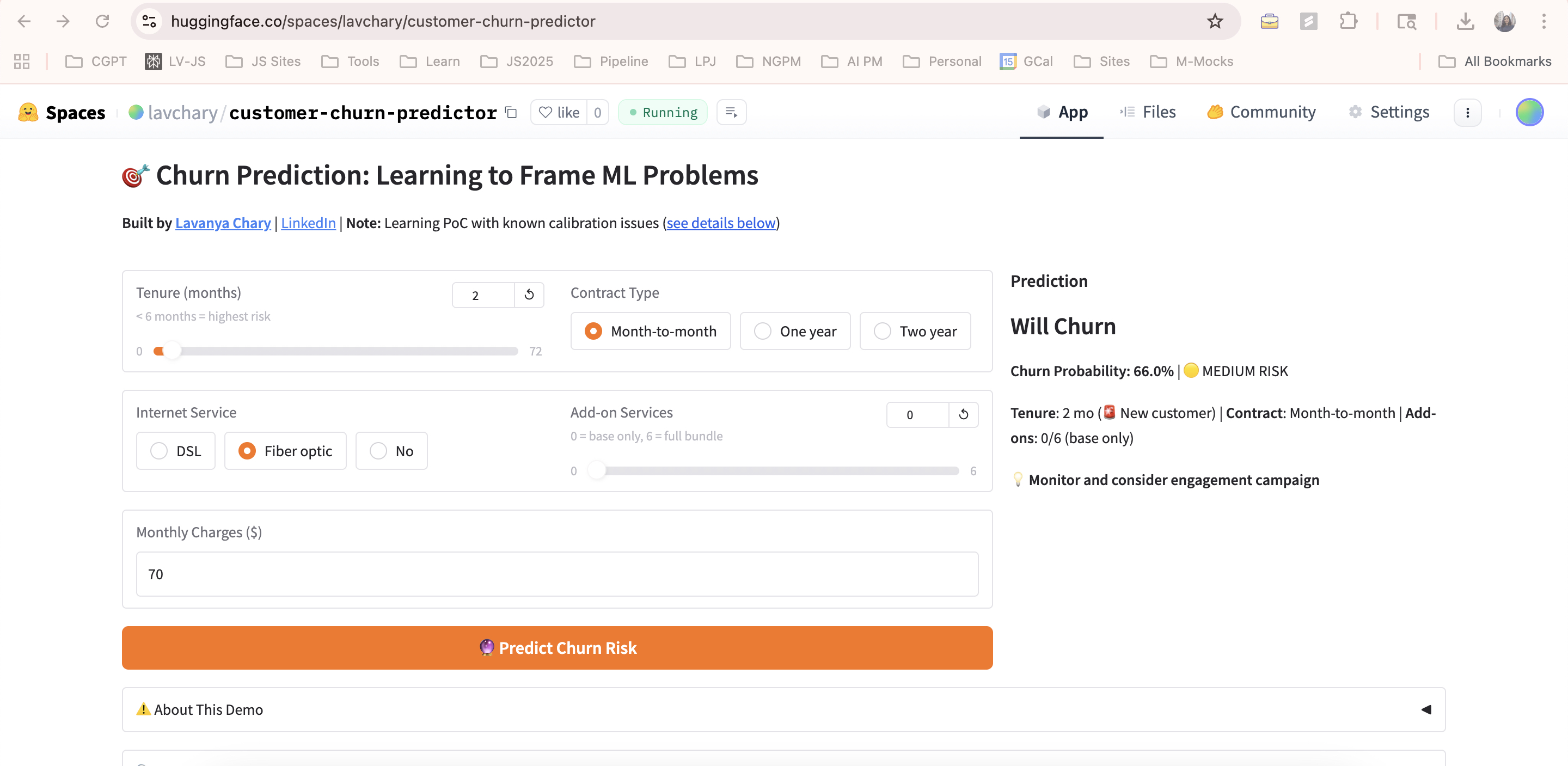
What the model revealed was more useful than its 81% accuracy score. A model you can explain is better than one that's more accurate but hard to understand.
So What?
Turning signals into retention action
- Focus on the first 6 months. That's when customers decide to stay or leave.
- Encourage longer commitments. Offer deals to move customers from month-to-month to annual plans.
- Combine services. When customers use more of what you offer, they're less likely to leave.
- Treat different customer groups differently. High-spending customers need a different approach than budget customers.
If We Deployed This
Evaluating performance
- Precision: Are we actually reaching at-risk customers?
- Recall: How much churn do we still miss?
- Cost of errors: What's the cost of wasted outreach vs. missing a retention opportunity?
- Segment bias: Does this work equally well across tenure, plans, and customer types?
- Explainability: Can we explain each prediction to stakeholders? Can they challenge it?